


Phone:+86 159 2114 7628


Transdermal Patches: Characteristics and Uses
Transdermal patches have been in widespread use for a couple of decades now. They have great advantages over other types of drug administration, but there's a limit to the number of active ingredients that you can administer through them.
Transdermal patches have their origins in medicines that, since ancient times, people have applied through the skin. Liniments, plasters, and ointments were alread used in ancient Greece, as a means of administering different medications.
In the 19th century, the idea emerged that the skin was impenetrable for certain medicines. Scientists held to this idea until the 20th century, when they proved that it waspossible to administer various drugs through the skin. In time, they developed these so-called transdermal patches, and they proved to be very functional.
Transdermal patches are part of the so-called “Controlled Release Therapeutic Systems“. They’re based on a principle postulated by John Urquhart, creator of the first skin patch. According to him, the therapeutic efficacy of a substance doesn’t depend on the dose. Rather, it depends on the speed and degree of its absorption.f the first skin patch. According to him, the therapeutic efficacy of a substance doesn’t depend on the dose. Rather, it depends on the speed and degree of its absorption.
What are transdermal patches?
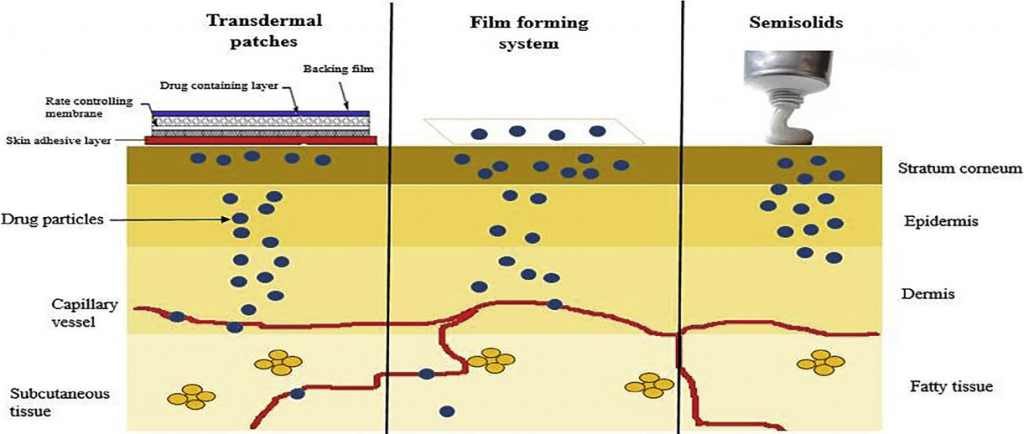
Transdermal patches are a way of administering medications. They attach to the skin with an adhesive and then release a drug continuously, ensuring that the skin absorbs it correctly. What we mean here is that it goes through the successive layers of skin, until it finally reaches the blood.
To administer a drug through the skin, it must have certain characteristics. The molecules that compose it must be lipophilic (that is, capable of being transported in lipids), and have a low molecular weight.
Likewise, they must have great pharmacological strength. This is because the body will only be able to absorb a small amount of product through the transdermal patches. At most, 10 milligrams per day.
Characteristics and use
Transdermal patches comprise four parts:
- A waterproof covering sheet
- A matrix or reservoir of the active ingredient, which houses the drug
- An adhesive
- A plastic sheet that doctors will remove before applying the patch
Some patches differ from others, mainly in the way the drug is stored and the way it’s released. Thus, there are basically three types of transdermal patches:
- Reservoir systems. The patch disperses the active ingredient through another substance and then releases it through a membrane. There are patches made of polypropylene, ethylene-vinyl-acetate copolymer, and also non-porous membrane.
- Matrix systems. The active ingredient is in a matrix and has a diffusing action, without the aid of a semi-permeable membrane.
- Mixed systems. These combine the two previous types.

Uses of transdermal patches
Currently, doctors can treat several diseases, symptoms, and problems by using transdermal patches. Among them, different types of pain, tobacco addiction, Alzheimer’s disease, Parkinson’s disease, and also several other applications.
Overall, the most commonly administered active ingredients in patch form are:
- Nitroglycerin. Mainly to prevent angina.
- Fentanyl and Buprenorphine. Doctors use these opiates for analgesic purposes.
- Nicotine. To help overcome addiction to tobacco.
- Ethinylestradiol + Norelgestromine. For contraceptive purposes.
- Estradiol, norethisterone. Used as a hormonal treatment during menopause.
- Testosterone. To treat the effects of surgical menopause.
- Rotigotine. For the treatment of Parkinson’s.
- Rivastigmine. For the treatment of Alzheimer's disease.
Also, there are several transdermal patches for cosmetic purposes. Among them, we can find body fat reducers, skin tighteners, and anti-cellulite.
Other information of interest
The Food and Drug Administration (FDA) has warned us about drugs that require special caution when administered transdermally. These are mainly contraceptives, opioid analgesics, and also rivastigmine.
Overall, the main advantages of these patches are:
- They facilitate the administration of drugs to people who have difficulty taking them orally.
- They offer more constant and sustained levels of the drug in the blood.
- Also, by using them, we prevent the metabolization of the drug through the liver, thus limiting several different potential side effects.
- Sometimes, they allow for a reduction in the frequency of administration and also improve compliance with the dosage.
Overall, the main disadvantage of these patches is that they sometimes produce an allergic reaction on the skin. Likewise, when an adverse reaction appears, it takes longer to disappear. They can also be aesthetically uncomfortable and are doctors are only able to use them with a small group of drugs.


Add: 5 Fl, 11 Bldg., No.6055 Jinhai Rd., Shanghai, China, CN-201403
Phone: +86 159 2114 7628 +86 138 0145 9525
Service: +86 159 2114 7628 (wechat, telegram same)
Email:charly.zhu@newradiance.cn
charly.zhu@hotmail.com ( teams, flock same)
QQ : 1160885331
mobile phone
 苏公网安备32100302011270号
Copyright © 2023. www.newradiance.cn.All rights reserved © New Radiance Packaging (Shanghai) Co., Ltd. 沪ICP备2023021591号-1
